Showing posts with label sherman. Show all posts

Thursday, August 1, 2013

Surrender of Gen. George H. Stoneman at the Battle of Sunshine Church (149th Anniversary)

Sunshine Church Battlefield - Round Oak, Georgia
149 years ago today on August 1, 1864, Maj. Gen. George H. Stoneman became the highest ranking Union officer to surrender during the entire War Between the States (or Civil War).

Stoneman's surrender took place on a hilltop 10 miles north of Gray, Georgia, at the end of the Battle of Sunshine Church. The engagement, which had begun the previous day, was one of the greatest Union disasters of the Atlanta Campaign.
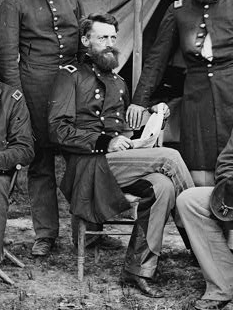
Maj. Gen. George H. Stoneman
The Northern politician/general had left Decatur on July 27, 1864, at the head of a column of 2,104 officers and men and only two pieces of artillery. His objective - as approved by Gen. William Tecumseh Sherman - was to break the railroad between Atlanta and Macon and then liberate the thousands of Union prisoners of war being held at Camp Oglethorpe (Macon) and Camp Sumter (Andersonville).

Sherman warned Stoneman, however, to let caution be his guide. He was to focus first on breaking the railroad, but he was not to try to make the long ride to Andersonville unless he was all but assured of success. The cavalry commander did not heed Sherman's advice and paid for his mistake with his reputation.

Driving south from Decatur, Stoneman and his men broke the railroad and did as much damage as possible, but also unleashed a fury of terror on civilian families, particularly women and children. Their targeting of civilians outraged people across the South and in particular outraged the Georgia Reserves and Militia assembling to meet them at Macon.

Confederate Earthworks at Dunlap Hill
Instead of sweeping aside reserves and militia as he appears to have expected to do, Stoneman ran into a buzzsaw when he reached Macon. Maj. Gen. Howell Cobb commanded the well-fortified Confederate forces at the Battle of Dunlap Hill on July 30, 1864. The Federals tried a poorly organized attack up the Clinton Road, but Cobb's forces drove them back and the sun set to the sound of "rebel yells" coming from the Confederate earthworks on the Dunlap Farm and at nearby Fort Hawkins.

It was then that Stoneman made the mistake that would destroy his reputation. Instead of immediately falling back to the safety of Sherman's army, he began looking for another way to get across the Ocmulgee River to continue his planned raid on Andersonville - a ride that would make him a hero across the North if he could complete it with success.

Brig. Gen. Alfred Iverson
Gen. Cobb, however, outsmarted his Union counterpart by sending Brig. Gen. Alfred Iverson with a large force of Confederate cavalry to take up a position between Macon and Sherman's army.

Iverson, who had not performed well at the head of an infantry brigade at the Battle of Gettysburg the previous year, was in his element as a commander of cavalry and was especially ready to carry out Cobb's orders. He had grown up in Clinton and knew the roads, farms and woods of Middle Georgia like the back of his hand. Swinging around behind Stoneman, he chose the site for the coming battle in an area of ravines, hills, woods and farms about 10 miles north of Gray and just south of the community of Round Oak.  A small rural chapel named Sunshine Church stood nearby.

When Stoneman learned that Confederate cavalry was moving to cut him off, he fell back from Macon to try to get to safety before it was too late. He reached Sunshine Church on July 31, 1864, to find that he had waited too long.  Iverson was entrenched along a ridge cutting off his route of retreat.

Iverson's Ridge at Sunshine Church
The Union general tried to cut his way through, but Iverson was too much for him.  A fierce battle raged through the ravines, hollows and ridges at Sunshine Church. Things got worse for Stoneman when troops sent north by Cobb to attack him from behind appeared to his rear.  With Confederates now holding the ridge ahead of him and coming up from behind, he decided he was trapped.

During the night of July 31-August 1, he met with his senior officers and ordered two of his brigades to try to cut their way out and escape while he remained behind with the rest of his men to sacrifice himself and buy time. They urged him not to resort to such action, but George Stoneman was already a a defeated man.

Sunshine Church II
Built north of the battlefield after
the War Between the States.
Capron's and Adams' brigades did break out (although Capron's brigade was soon cut to pieces at the Battle of King's Tanyard near Athens). Stoneman held on a hilltop - known today as Stoneman's Hill - for a short time before surrendering to Iverson. He barely escaped being hanged from the nearest tree by the Confederates, who were infuriated over the attacks on civilians carried out by the Union raiders.

149 years ago today, George H. Stoneman began his journey to a Confederate prisoner of war camp. It would be months before he was released and he holds the dubious distinction of being the highest ranking Union officer captured during the four years of bloody war.

To learn more about the Battle of Sunshine Church, please visit www.exploresouthernhistory.com/sunshinechurch.

To learn more about the preliminary action at the Battle of Dunlap Hill, please visit www.exploresouthernhistory.com/dunlaphill.


Friday, July 8, 2011

Old Governor's Mansion - Milledgeville, Georgia

Old Governor's Mansion
One of the finest examples of Greek revival architecture in the nation, Georgia's historic Old Governor's Mansion has been a landmark of Milledgeville for 175 years.

Built of brick faced with stucco, the magnificent old mansion was designed and constructed in the days when Milledgeville was still the "new" capital of Georgia. The Old Capitol Building stands just up the street and the landscape of the charming historic city is dotted with other reminders of its days as capital of the state.

The home was built in 1836-1839 and first occupied by Governor George Gilmer, who moved in as the mansion was completed in 1839.  Other occupants over the years included Governor (and later Confederate general) Howell Cobb and Georgia's noted Confederate governor, Joseph Brown.

Old Governor's Mansion
A less popular temporary resident - General William Tecumseh Sherman - occupied the house for a night during his infamous March to the Sea. Union troops camped in the yards after their occupation of Milledgeville.

The house remained the home of the state's governor until the Reconstruction era when the post-war legislature voted to relocate the capitol to Atlanta. It later served as a barracks for cadets of what is now the Georgia Military College and as the resident for the president of today's Georgia College and State University.

Now a museum, the Old Governor's Mansion has been beautifully restored. Learn more by visiting www.exploresouthernhistory.com/gaoldmansion.

Saturday, June 25, 2011

St. Stephens Episcopal Church - Milledgeville, Georgia

St. Stephens Episcopal Church
Built in 1843, Milledgeville's historic St. Stephens Episcopal Church is a unique landmark of General William Tecumseh Sherman's devastating March to the Sea.

A prominent feature of Statehouse Square, St. Stephens was built in the days when Milledgeville was still the capital city of Georgia. The church stands almost in the shadow of the state's beautiful Old Capitol building and its walls once sheltered the worship of some of Georgia's most prominent citizens.

Episcopal churches in the South were major centers of secession sentiment during the years leading up to the Civil War. From the highest level down to the parish churches, Episcopalians heard strong messages from their leaders urging them to support Southern independence.

A Survivor of the March to the Sea
For this reason, Northern troops often desecrated Episcopal churches as they marched through the Southern states. This was the case at St. Stephens.

As Sherman's troops marched into Milledgeville on November 11, 1864, they quickly took note of St. Stephens Church. The pews were burned for firewood. The sanctuary was used as a stable for horses. Molasses was even poured down the pipes of the organ. The greatest damage, however, came as the Federals marched out of Savannah to continue their March to the Sea. The Confederate armories were set fire and a massive explosion caused by the combination of fire and munitions rocked Statehouse Square. The roof of the church was demolished by the blast.

Like most other Southern churches, however, St. Stephens Episcopal Church survived the war, rebuilt the roof in a new style, and remains active today.

To learn more about this historic Georgia church, please visit www.exploresouthernhistory.com/ststephens.

Wednesday, June 22, 2011

Forsyth Park in Savannah, Georgia - A 19th Century Dream is Realized

Forsyth Park in Savannah, Georgia
When the planners of Savannah's antebellum city expansion conceived the idea of a large public park, the visualized it as a place around which neighborhoods would grow as well as culmination of color and beauty for the city's Bull Street Corridor.

More than 150 years later, their vision has been realized in the form of Forsyth Park. A magnificent 30-acre greenspace created in the years before the Civil War, the park is one of the most magnificent to be found in any city in the world. Its beautiful fountain, which can be seen as you approach along Bull Street from Monterey Square, has flowed since 1858 and is patterned after a similar feature in Paris. Shrouded by beautiful oak trees, it is one of the most photographed spots in the historic city.

Forsyth Park in Savannah
The history of this ground actually began long before the creation of the park by early city planners. General Oglethorpe himself reserved this ground when he created Savannah and its 24 magnificent squares. During the American Revolution, French troops camped here and their siege trenches began in what is now the northern end of the park.

By the time Sherman came in 1864, Forsyth Park was a developing reality. His men also camped here and thankfully spared Savannah from the flames they visited on Atlanta, Columbia and other locations they visited.

Today, Forsyth Park is everything its 19th century planners dreamed and more. A magnificent setting, it is popular with residents and visitors alike. To learn more, please visit www.exploresouthernhistory.com/forsythpark.

Monday, February 22, 2010

Stone Mountain, Georgia - History Written in Granite

Stone Mountain Park on the outskirts of Atlanta is home to one of Georgia's most unique historic sites.

Once thought to be the largest such granite outcrop in the world, Stone Mountain has witnessed the passage of thousands of years of Georgia history. Ancient Native Americans, for example, built mysterious stone walls atop the mountain. The purpose of these walls, which do not seem to have been designed as fortifications, is not clear, although most researchers now speculate they were ceremonial in nature. No trace of them remains today.

During the Civil War, the mountain was a key stop on Sherman's March to the Sea. Numerous soldiers describe stopping to admire the view of the impressive mountain of stone, even as they torched local barns and took every scrap of food they could find, leaving hard-working Georgia families to starve.

In later years, the mountain provided a source for granite during the construction boom that followed the Reconstruction years. Stone Mountain granite can be found in public structures and monuments across the South. The term "As Solid as Stone Mountain" became symbolic of the spirit of the New South.

The face of the mountain now displays the world's largest bas-relief carving. The figures of Jefferson Davis, Robert E. Lee and Stonewall Jackson ride on horseback across the face of the mountain, frozen in time.

Stone Mountain Park is a popular tourist destination. To learn more, please visit www.exploresouthernhistory.com/stonemountain.