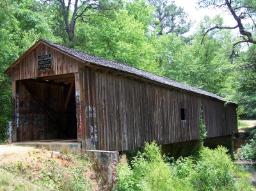
Just outside of Blakely in Early County stands the Coheelee Creek Covered Bridge, the southernmost original covered bridge in the United States.
Built in 1891 at the old McDonald Ford over Coheelee Creek, the bridge is 96 feet long and was constructed at a cost of only $490.41. That was actually a substantial sum in that day and time, but it was the work of builder John William Baughman that really stood the test of time.
The classic old bridge, weathered and charming, no longer carries car traffic but still feels solid to the feet as you walk across it. Like many such structures, it does suffer from vandalism and is not as well-kept as it could be, but to see a covered bridge standing so far down in the Deep South is truly remarkable.
The Coheelee Creek bridge is even more unique because it spans one of the few waterfalls to be found this far down in Georgia. The rushing water of the creek tumbles over rocks create a small cascade or fall that can be heard as you approach the bridge.
To learn more, please visit www.exploresouthernhistory.com/coheelee1.
This blog provides information on the fascinating history, historic sites and great points of interest in Georgia, with a focus on both cultural and natural history. Posts are made regularly by Southern author and historian Dale Cox.
Monday, June 21, 2010
Sunday, June 20, 2010
Jekyll Island - Historic Sites and Points of Interest
There can be little doubt that Jekyll Island on Georgia's Atlantic Coast is one of the most charming and historic spots in the South.
The Guale Indians were living here when the Spanish first arrived in North America during the 1500s. Missions were established in the area and for many years the Golden Isles of Georgia were considered a Spanish possession.
That changed in 1736, when General James Oglethorpe arrived across the channel on St. Simons Island to establish Fort Frederica and Fort St. Simons. One of the general's top officers, Major William Horton, was granted 500 acres on Jekyll Island and in 1736 he became the island's first recorded permanent inhabitant.
Horton built a two-story fortified home on the northern end of Jekyll Island, cleared the first road across the island and opened fields for farming. He also operated a brewery which supplied beer for the troops occupying the coastal islnds. Horton's house was burned by the Spanish in 1742, but its stout tabby walls remained and the structure was rebuilt.
In the years that followed, Jekyll Island was the location of plantations and a Confederate artillery battery. After the Civil War, however, the entire island was acquired by a group of the wealthiest and most powerful individuals in the world. The Jekyll Island Club, as their private organization was known, began with 53 member-investors. Among them were J.P. Morgan, Joseph Pulitzer, Marshall Field and William K. Vanderbilt.
The clubhouse on the island opened its doors in 1888 and millionaires flocked to the island to build magnificent winter cottages. For nearly fifty years, Jekyll Island would be a seat of power unlike any in America. It was from meetings here that the idea for forming the Federal Reserve grew and it was from Jekyll Island that the president of AT&T placed the first transcontinental telephone call in 1915.
Jekyll Island today is owned by the State of Georgia and is a popular destination for visitors from around the world. To learn more, please visit www.exploresouthernhistory.com/jekyllisland.
The Guale Indians were living here when the Spanish first arrived in North America during the 1500s. Missions were established in the area and for many years the Golden Isles of Georgia were considered a Spanish possession.
That changed in 1736, when General James Oglethorpe arrived across the channel on St. Simons Island to establish Fort Frederica and Fort St. Simons. One of the general's top officers, Major William Horton, was granted 500 acres on Jekyll Island and in 1736 he became the island's first recorded permanent inhabitant.
Horton built a two-story fortified home on the northern end of Jekyll Island, cleared the first road across the island and opened fields for farming. He also operated a brewery which supplied beer for the troops occupying the coastal islnds. Horton's house was burned by the Spanish in 1742, but its stout tabby walls remained and the structure was rebuilt.
In the years that followed, Jekyll Island was the location of plantations and a Confederate artillery battery. After the Civil War, however, the entire island was acquired by a group of the wealthiest and most powerful individuals in the world. The Jekyll Island Club, as their private organization was known, began with 53 member-investors. Among them were J.P. Morgan, Joseph Pulitzer, Marshall Field and William K. Vanderbilt.
The clubhouse on the island opened its doors in 1888 and millionaires flocked to the island to build magnificent winter cottages. For nearly fifty years, Jekyll Island would be a seat of power unlike any in America. It was from meetings here that the idea for forming the Federal Reserve grew and it was from Jekyll Island that the president of AT&T placed the first transcontinental telephone call in 1915.
Jekyll Island today is owned by the State of Georgia and is a popular destination for visitors from around the world. To learn more, please visit www.exploresouthernhistory.com/jekyllisland.
Labels:
georgia,
historic sites,
horton house,
jekyll island,
jekyll island club
Wednesday, May 12, 2010
Red Oak Covered Bridge - Woodbury, Georgia
Sometimes called the Imlac Covered Bridge after a nearby unincorporated community of that name, the historic Red Oak Covered Bridge in Woodbury is Georgia's oldest original covered bridge.
Built in the 1840s by famed bridge builder Horace King, the Red Oak bridge is also the longest wooden bridge in Georgia. Counting its open approaches, it is 253 feet long. The main covered part of the bridge is 115 feet long.
Uniquely, the Red Oak Covered Bridge is still in use today. Cars cross Red Oak Creek by using the bridge, which is still as solid as it was when it was built, thanks to careful preservation and occasional repair work. Listed on the National Register of Historic Places, the bridge is easily accessible from nearby Warm Springs by way of Georgia Highway 85.
The bridge is a unique surviving example of the engineering skill of its builder, Horace King. Born into slavery in South Carolina, King demonstrated such remarkable capability as an engineer and architect that he was set free by John Godwin. His reputation was so established by that point that the Alabama State Legislature enacted special legislation granting King the full rights of citizenship.
Although he and his sons are best remembered for their work designing and building bridges, they also achieved remarkable results on other projects. Horace King, for example, is remembered today as the designer and builder of the beautiful spial staircase in the Alabama State Capitol.
To learn more about Red Oak Covered Bridge, please visit www.exploresouthernhistory.com/redoak.
Built in the 1840s by famed bridge builder Horace King, the Red Oak bridge is also the longest wooden bridge in Georgia. Counting its open approaches, it is 253 feet long. The main covered part of the bridge is 115 feet long.
Uniquely, the Red Oak Covered Bridge is still in use today. Cars cross Red Oak Creek by using the bridge, which is still as solid as it was when it was built, thanks to careful preservation and occasional repair work. Listed on the National Register of Historic Places, the bridge is easily accessible from nearby Warm Springs by way of Georgia Highway 85.
The bridge is a unique surviving example of the engineering skill of its builder, Horace King. Born into slavery in South Carolina, King demonstrated such remarkable capability as an engineer and architect that he was set free by John Godwin. His reputation was so established by that point that the Alabama State Legislature enacted special legislation granting King the full rights of citizenship.
Although he and his sons are best remembered for their work designing and building bridges, they also achieved remarkable results on other projects. Horace King, for example, is remembered today as the designer and builder of the beautiful spial staircase in the Alabama State Capitol.
To learn more about Red Oak Covered Bridge, please visit www.exploresouthernhistory.com/redoak.
Tuesday, May 4, 2010
Georgia Sea Turtle Center - Jekyll Island, Georgia
Sea turtles, some of which grow to lengths of more than 6 feet, have long been fixtures of the Georgia coast.
Prehistoric Native Americans made use of these large turtles as food and early European settlers were also known to cook one up now and then as well. It was not until 20th century development and other impacts set in, however, that Georgia's population of sea turtles was threatened.
There are five different species of sea turtles in Georgia and all are now protected by both state and federal law. They are a unique and special part of not only the cultural, but the natural history of Georgia.
One of the most unique places to learn about and actually see them is the Georgia Sea Turtle Center on Jekyll Island. Located in the beautiful Jekyll Island Historic District, the center offers an interpretive center featuring interactive exhibits about sea turtles, but even more importantly serves to rescue and rehabilitate injured or sick sea turtles from all along the coastal islands.
Guides take visitors on tours of the hospital area, where they can see the staff working to heal and help sometimes very large sea turtles. It is a unique experience and one that should definitely not be overlooked by visitors to the Georgia coast.
To learn more, please visit www.exploresouthernhistory.com/jekyllturtles.
Prehistoric Native Americans made use of these large turtles as food and early European settlers were also known to cook one up now and then as well. It was not until 20th century development and other impacts set in, however, that Georgia's population of sea turtles was threatened.
There are five different species of sea turtles in Georgia and all are now protected by both state and federal law. They are a unique and special part of not only the cultural, but the natural history of Georgia.
One of the most unique places to learn about and actually see them is the Georgia Sea Turtle Center on Jekyll Island. Located in the beautiful Jekyll Island Historic District, the center offers an interpretive center featuring interactive exhibits about sea turtles, but even more importantly serves to rescue and rehabilitate injured or sick sea turtles from all along the coastal islands.
Guides take visitors on tours of the hospital area, where they can see the staff working to heal and help sometimes very large sea turtles. It is a unique experience and one that should definitely not be overlooked by visitors to the Georgia coast.
To learn more, please visit www.exploresouthernhistory.com/jekyllturtles.
Labels:
georgia,
georgia sea turtle center,
jekyll island,
sea turtles
Friday, April 16, 2010
The Marshes of Glynn - Glynn County, Georgia
It is a little known fact that Georgia has (and protects) more salt marsh than any other state on the East Coast of the United States. Perhaps the best known of these grasslands are the Marshes of Glynn, which separate Jekyll, St. Simons and the other Golden Isles from the mainland of Georgia.
Vast seas of grass that team with life, the Marshes of Glynn are part of one of the most productive eco-systems in the world. They are the breeding grounds for Georgia shrimp, blue crab and oysters and also filter pollutants from water.
The marshes have long attracted the attention of mankind, but they owe their greatest fame to the poet Sidney Lanier. In 1878, he penned his beautiful poem "The Marshes of Glynn," a widely acclaimed work that provides one of the finest word pictures ever written of an American landscape.
The marshes can be seen from the causeways leading to both St. Simons Island and Jekyll Island. The overlook at the Jekyll Island Welcome Center provides a spectacular panoramic view of the marshes, and they can also be seen from many points along the interior coast of Jekyll Island. A particularly beautiful spot is on the grounds of the Horton House Historic Site.
To learn more, please visit www.exploresouthernhistory.com/marshesofglynn.
Vast seas of grass that team with life, the Marshes of Glynn are part of one of the most productive eco-systems in the world. They are the breeding grounds for Georgia shrimp, blue crab and oysters and also filter pollutants from water.
The marshes have long attracted the attention of mankind, but they owe their greatest fame to the poet Sidney Lanier. In 1878, he penned his beautiful poem "The Marshes of Glynn," a widely acclaimed work that provides one of the finest word pictures ever written of an American landscape.
The marshes can be seen from the causeways leading to both St. Simons Island and Jekyll Island. The overlook at the Jekyll Island Welcome Center provides a spectacular panoramic view of the marshes, and they can also be seen from many points along the interior coast of Jekyll Island. A particularly beautiful spot is on the grounds of the Horton House Historic Site.
To learn more, please visit www.exploresouthernhistory.com/marshesofglynn.
Sunday, April 4, 2010
Warm Springs Area Historic Sites
Spring is a phenomenal time to visit the historic West Georgia community of Warm Springs. The dogwoods, azaleas and other natural plants are in bloom and comfortable temperatures have returned, making the easy drive from nearby Atlanta or Columbus well worth the time.
Located just off the northern slope of Pine Mountain, Warm Springs is rich in both natural and cultural history. The community is a popular gateway to nearby Callaway Gardens, one of the finest outdoor attractions in the South, Warm Springs is also known for its unique old downtown area, President Franklin D. Roosevelt's Little White House and an array of other sites associated with the man who guided America through the Great Depression and World War II.
A beautifully revitalized historic community, Warm Springs is centered around the site of the train station from which President Roosevelt's body was taken in 1945 after he died at the Little White House. A monument marks the train station site and visitors can tour many other sites associated with Roosevelt, including the restored warm water pools that once attracted him to Warm Springs in hope of finding help for the disabling results of his battle with polio. The Little White House is open to the public daily and the nearby Franklin D. Roosevelt State Park includes numerous other areas associated with the late president.
In addition, the scenery of Pine Mountain is just spectacular. Historic Dowdell's Knob offers stunning views of the valley below and trails lead to small waterfalls, rock formations and other unique settings.
To learn more about the Warm Springs area, please visit www.exploresouthernhistory.com/warmsprings.
Located just off the northern slope of Pine Mountain, Warm Springs is rich in both natural and cultural history. The community is a popular gateway to nearby Callaway Gardens, one of the finest outdoor attractions in the South, Warm Springs is also known for its unique old downtown area, President Franklin D. Roosevelt's Little White House and an array of other sites associated with the man who guided America through the Great Depression and World War II.
A beautifully revitalized historic community, Warm Springs is centered around the site of the train station from which President Roosevelt's body was taken in 1945 after he died at the Little White House. A monument marks the train station site and visitors can tour many other sites associated with Roosevelt, including the restored warm water pools that once attracted him to Warm Springs in hope of finding help for the disabling results of his battle with polio. The Little White House is open to the public daily and the nearby Franklin D. Roosevelt State Park includes numerous other areas associated with the late president.
In addition, the scenery of Pine Mountain is just spectacular. Historic Dowdell's Knob offers stunning views of the valley below and trails lead to small waterfalls, rock formations and other unique settings.
To learn more about the Warm Springs area, please visit www.exploresouthernhistory.com/warmsprings.
Saturday, March 13, 2010
Horton House Historic District - Jekyll Island, Georgia
The old Horton House on Jekyll Island has been one of my favorite historic sites since I first saw the picturesque ruins as a kid.
A relic of Georgia's Colonial past, the Horton House was built by Major William Horton in around 1740 as English settlement spread south through the Golden Isles following the establishment of Fort Frederica on nearby St. Simons Island by General James Oglethorpe. Horton was the major and second command of Oglethorpe's regiment and his settlement on the north end of Jekyll Island was a major part of Oglethorpe's plan for conquering the former Spanish territory along the Georgia coast.
The two-story house was extremely large for its day and was made of tabby, a concrete like material created by mixing equal parts of lime (made by burning oyster shells), sand, water and oyster shell. The fact that the walls still stand more than 270 years later reveals just how strong tabby was as a building material. In addition to the house, Horton built a barn and other structures, cleared fields and opened the first road across Jekyll Island.
The Spanish burned the Horton House during their raid on St. Simons and Jekyll Islands in 1742, but it was quickly rebuilt using the surviving stone walls. In fact, the house remained the centerpiece of an important plantation until the lands were sold to the Jekyll Island Club in 1886. The old walls witnessed not only the War of Jenkins Ear with the Spanish, but the American Revolution, War of 1812 and Civil War as well.
The house and grounds are today maintained as a historic site and feature not only the old ruins, but interpretive markers, the nearby DuBignon (du Bignon) cemetery and spectacular views of the famed Marshes of Glynn. To learn more, please visit www.exploresouthernhistory.com/hortonhouse.
A relic of Georgia's Colonial past, the Horton House was built by Major William Horton in around 1740 as English settlement spread south through the Golden Isles following the establishment of Fort Frederica on nearby St. Simons Island by General James Oglethorpe. Horton was the major and second command of Oglethorpe's regiment and his settlement on the north end of Jekyll Island was a major part of Oglethorpe's plan for conquering the former Spanish territory along the Georgia coast.
The two-story house was extremely large for its day and was made of tabby, a concrete like material created by mixing equal parts of lime (made by burning oyster shells), sand, water and oyster shell. The fact that the walls still stand more than 270 years later reveals just how strong tabby was as a building material. In addition to the house, Horton built a barn and other structures, cleared fields and opened the first road across Jekyll Island.
The Spanish burned the Horton House during their raid on St. Simons and Jekyll Islands in 1742, but it was quickly rebuilt using the surviving stone walls. In fact, the house remained the centerpiece of an important plantation until the lands were sold to the Jekyll Island Club in 1886. The old walls witnessed not only the War of Jenkins Ear with the Spanish, but the American Revolution, War of 1812 and Civil War as well.
The house and grounds are today maintained as a historic site and feature not only the old ruins, but interpretive markers, the nearby DuBignon (du Bignon) cemetery and spectacular views of the famed Marshes of Glynn. To learn more, please visit www.exploresouthernhistory.com/hortonhouse.
Labels:
georgia,
historic site,
horton house,
jekyll island
Monday, February 22, 2010
Stone Mountain, Georgia - History Written in Granite
Stone Mountain Park on the outskirts of Atlanta is home to one of Georgia's most unique historic sites.
Once thought to be the largest such granite outcrop in the world, Stone Mountain has witnessed the passage of thousands of years of Georgia history. Ancient Native Americans, for example, built mysterious stone walls atop the mountain. The purpose of these walls, which do not seem to have been designed as fortifications, is not clear, although most researchers now speculate they were ceremonial in nature. No trace of them remains today.
During the Civil War, the mountain was a key stop on Sherman's March to the Sea. Numerous soldiers describe stopping to admire the view of the impressive mountain of stone, even as they torched local barns and took every scrap of food they could find, leaving hard-working Georgia families to starve.
In later years, the mountain provided a source for granite during the construction boom that followed the Reconstruction years. Stone Mountain granite can be found in public structures and monuments across the South. The term "As Solid as Stone Mountain" became symbolic of the spirit of the New South.
The face of the mountain now displays the world's largest bas-relief carving. The figures of Jefferson Davis, Robert E. Lee and Stonewall Jackson ride on horseback across the face of the mountain, frozen in time.
Stone Mountain Park is a popular tourist destination. To learn more, please visit www.exploresouthernhistory.com/stonemountain.
Once thought to be the largest such granite outcrop in the world, Stone Mountain has witnessed the passage of thousands of years of Georgia history. Ancient Native Americans, for example, built mysterious stone walls atop the mountain. The purpose of these walls, which do not seem to have been designed as fortifications, is not clear, although most researchers now speculate they were ceremonial in nature. No trace of them remains today.
During the Civil War, the mountain was a key stop on Sherman's March to the Sea. Numerous soldiers describe stopping to admire the view of the impressive mountain of stone, even as they torched local barns and took every scrap of food they could find, leaving hard-working Georgia families to starve.
In later years, the mountain provided a source for granite during the construction boom that followed the Reconstruction years. Stone Mountain granite can be found in public structures and monuments across the South. The term "As Solid as Stone Mountain" became symbolic of the spirit of the New South.
The face of the mountain now displays the world's largest bas-relief carving. The figures of Jefferson Davis, Robert E. Lee and Stonewall Jackson ride on horseback across the face of the mountain, frozen in time.
Stone Mountain Park is a popular tourist destination. To learn more, please visit www.exploresouthernhistory.com/stonemountain.
Sunday, December 27, 2009
Battle of Chickamauga, Georgia
The Battle of Chickamauga, fought on September 19 & 20, 1863, was one of the bloodiest battles ever witnessed on the American continent.
Fought in the woods and small fields along the west side of Chickamauga Creek near the modern community of Fort Oglethorpe, the battle resulted in losses of 34,000 killed, wounded and missing from the two armies. It was described by many as a "soldier's fight," because in many cases soldiers stumbled and struggled through overgrown woods with little direction and surrounded by the smoke and confusion of battle.
Chickamauga was also one of the most dramatic Confederate victories of the Civil War. General James Longstreet's Corps attacked just as a gap was accidentally opened in the Union lines. Southern troops pierced the Union line of battle and the Federal army of General William S. Rosecrans collapsed in panic, with only the men under General George H. Thomas, the "Rock of Chickamauga," holding their ground on Snodgrass Hill.
The scene of Braxton Bragg's great victory is now preserved as a unit of the Chickamauga & Chattanooga National Military Park. Other units include Point Park on Lookout Mountain, small reserves on Missionary Ridge and several other areas in and around Chattanooga, Tennessee. The Chickamauga unit is the largest section of the park, however, and features tour roads, monuments, a magnificent visitor center and interpretive markers that help visitors explore the miles of battlefield. To learn more, please visit www.exploresouthernhistory.com/chickamauga. You might also enjoy the new film on the battle which is now available on DVD:
Thursday, December 17, 2009
A Georgia Connection to "Hark! The Herald Angels Sing"

It is a little known fact that the English evangelist Charles Wesley, who penned the beautiful Christmas hymn "Hark! The Herald Angels Sing" spent time on the coast of Georgia.
He and his brother, Rev. John Wesley, came to Georgia with General James Oglethorpe in the early days of the Georgia colony. Then a young man, Charles Wesley served as Secretary for Indian Affairs and chaplain for General Oglethorpe, and worked hard with his brother to minister to the early settlers of the colony. Both were closely associated with both Savannah and the military settlement of Fort Frederica on St. Simons Island.
After he left Georgia, Charles Wesley went on to pen many Christian hymns and poems. One of the best known, especially at this season, is "Hark! The Herald Angels Sing."
The efforts of the Wesley brothers are memorialized today on St. Simons Island at the Wesley Memorial Gardens. Surrounded by magnificent trees, the beautiful gardens compliment a stunning monument dedicated to the ministry of the two brothers.
To learn more, please visit www.exploresouthernhistory.com/wesleymemorial.
Friday, December 11, 2009
The Nancy Harts - Georgia's Female Civil War Soldiers

One of the most unique stories of the Civil War in Georgia is that of the famed Nancy Harts, LaGrange's all-female militia company.
Named for Nancy Hart, a Georgia heroine of the the American Revolution, the LaGrange company was formed in 1862 after many of the regular Confederate troops were pulled from the area. Concerned over the fate of their community and the safety of their families, the ladies of LaGrange organized into a volunteer company for the purpose of local defense. Electing Nancy Morgan as their captain, the soldiers began drilling twice weekly in a grove owned by Senator Benjamin Harvey Hill.
The women also served as nurses in the local military hospitals, which overflowed with wounded during the Atlanta Campaign. But in 1865, it appeared that they might actually face their baptism of fire. The column of Union Colonel O.H. LaGrange approached LaGrange (the city is not named for him) after taking Fort Tyler at nearby West Point. Learning that the Federals were approaching, the Nancy Harts formed ranks and marched out to meet him.
To learn the rest of the story, please visit www.exploresouthernhistory.com/nancyharts.
Tuesday, December 8, 2009
Ocmulgee National Monument - Macon, Georgia

One of the most remarkable archaeological sites in America can be found just minutes from downtown Macon.
Ocmulgee National Monument preserves a massive collection of ceremonial mounds and other Native American sites dating from the Mississippian era (900-1450 A.D.). The Ocmulgee site reached its height 900 to 1100 years ago, when it was the center of a massive chiefdom that covered hundreds of square miles in the central part of Georgia.
Now a national park that is open to the public daily, the Ocmulgee site features both self-guided walking and driving tours, a visitor center, the mounds and a restored earth lodge where high status leaders once conducted important councils centuries ago. The top of the great temple mound can be accessed by stairs and provides a spectacular view of the entire site, as well as the city of Macon itself.
To learn more, please visit www.exploresouthernhistory.com/ocmulgeemounds1.
Tuesday, October 27, 2009
Ghost of the Springer Opera House - Columbus, Georgia

One of the most unique ghost stories in Georgia is the tale that surrounds the stunning Springer Opera House in Columbus.
Built during the turbulent years of the Reconstruction Era, the Springer has hosted some of the world's top actors and political leaders over the years. Will Rogers once entertained audiences from its stage and William Jennings Bryan and Franklin Delano Roosevelt discussed their dreams for the future of America in the Springer.
But if old Columbus legends are to be believed, one of the theater's most famous guests is still hanging around.
Actor Edwin Booth, the brother of John Wilkes Booth who killed President Abraham Lincoln, came to the Springer to revive his career during the 1870s. With other members of his family, he had gone into voluntary seclusion following the Lincoln assassination. As time passed, however, he decided to try for a "come back" and the Springer was a key stop on that road.
Booth, as the story goes, so loved the Springer and its cheering audiences that he came back after his death to haunt the beautiful old theater. Described as a playful ghost, he supposedly teases female visitors and is said to enjoy causing trouble in the wardrobe area.
To learn more about the Ghost of Springer Opera House, please visit www.exploresouthernhistory.com/springerghost.
Labels:
columbus,
georgia,
ghost,
spring,
springer opera house
Saturday, October 17, 2009
Fort Frederica National Monument - St. Simons Island, Georgia

Fort Frederica National Monument on St. Simons Island has been one of my favorite historic sites since my parents took me there when I was maybe 8 or 9 years old. It is hard not to be fascinated with the massive old oaks and the picturesque ruins of Oglethorpe's colonial settlement.
The fort was established in 1736 by English General James Oglethorpe, the founder of the Georgia colony, who anticipated that it would serve as a barrier to Spanish attacks on his fledgling colony and its capital of Savannah. His plan proved very prophetic.
The War of Jenkins' Ear (named for the severed ear of a captured English sea captain) spread to America and Oglethorpe launched a campaign against St. Augustine, Florida, in an effort to capture the Spanish capital. He was unable to reduce the powerful fort of Castillo de San Marcos and withdrew back to Georgia. Two years later, in 1742, Spanish Governor Don Manuel de Montiano retaliated by leading a fleet of warships and an army of 5,000 men north to Georgia.
Fort Frederica by that time had evolved into a powerful citadel on the riverfront and a growing English village surroun
ded by a stout wall of earth and timber. Spanish ships briefly engaged the cannon of the fort and Montiano attempted to carry out land operations but was defeated by the English at the Battles of Gully Hole Creek and Bloody Marsh.Frederica survived, as did Oglethorpe's colony of Georgia. Peace returned to the frontier and Georgia grew. The return of peace, however, ultimately spelled the end of Fort Frederica. There was no need for the garrison there and with the end of the garrison came the end of the English village on St. Simons Island. The town dwindled away, was largely destroyed by fire before the American Revolution and ultimately was reclaimed by the forest.
To learn more, please visit www.exploresouthernhistory.com/fortfrederica.
Wednesday, October 14, 2009
Fort St. Simons - St. Simons Island, Georgia

Often overlooked because it stands in the shadow of the popular and historic St. Simons Lighthouse, a small monument marks the site of Fort St. Simons, one of Georgia's least known coastal forts.
Built in 1738 by the English under James Oglethorpe, the fort was an outpost of nearby Fort Frederica and stood on the southern tip of St. Simons Island. Its purpose was to prevent enemy warships - primarily those of Spain - from entering St. Simons Sound. A bastioned work of earth and wood, Fort St. Simons was armed with 18-pounders, relatively heavy guns for the day.
The fort was tested in 1742 during a key battle of the War of Jenkins' Ear, a conflict between England and Spain named after the severed ear of an English sea captain who had been captured by the Spanish. Despite the strength of its artillery, the fort was unable to hold back a a large Spanish fleet that stormed into the sound in July. Passing the fort, the Spanish landed an army of nearly 5,000 men.
Realizing that he could not hold Fort St. Simons against such an overwhelming force, Oglethorpe spiked its guns and withdrew to his main defenses at Fort Frederica. The Spanish then occupied the ruined fort, using it as a base for their operations on the island over the coming weeks. Troops marched out from the fort for the Battles of Gully Hole Creek and Bloody Marsh.
To learn more about Fort St. Simons, please visit www.exploresouthernhistory.com/fortstsimons.
Labels:
fort frederica,
fort st. simons,
georgia,
st. simons island
Wednesday, September 9, 2009
Fort Tyler - West Point, Georgia

Often overlooked by those who spend time visiting sites associated with Georgia's Civil War history, Fort Tyler in West Point preserves a fascinating Confederate fort that was a key objective during one of the last battles of the war.
Commanded by Brigadier General R.C. Tyler, a wounded veteran with a reputation for courage, and manned by a force variously estimated at from 12o to 265 Confederate regulars, militia, volunteers and wounded soldiers from local hospitals, the little fort held out against 3,750 Union soldiers for the better part of a day.
The Battle of West Point took place on April 16, 1865, an Easter Sunday. General Robert E. Lee had surrendered his forces in Virginia seven days earlier, but Tyler was not so inclined. When the ladies of the area presented him a flag on the eve of the battle, he swore that he would prevail or die in the effort. He kept his word.
As Fort Tyler came under fire from all directions, the Confederate troops within its walls fought bravely. A Union cannon shot cut the flag halyard, but a 17-year-old volunteer climbed the pole and put the flag back in place. In the end, though, General Tyler knew that the fall of the fort was inevitable. His cannon had been dismounted by Union shelling and his men were falling around him. In a final show of defiance, he exposed himself to the fire of the attacking Federals, walking in clear view until he was shot down.
Tyler was the last general on either side killed during the War Between the States. Fort Tyler surrendered not long after his death, its defenders sustained a loss of 19 killed and 28 wounded.
The earthworks of the fort were eventually destroyed to make way for a city reservoir, but in a remarkable restoration project the underground remains of Fort Tyler were discovered by archaeologists, who provided the information necessary to rebuilt the fort on its original site.
Today Fort Tyler stands again in a beautifully maintained park in West Point. To learn more, please visit www.exploresouthernhistory.com/forttyler.
Labels:
battle,
fort tyler,
georgia,
r.c. tyler,
west point
Friday, September 4, 2009
Andersonville National Historic Site - Andersonville, Georgia

Home to the National Prisoner of War Museum, Georgia's Andersonville National Historic Site is a place for reflection on the cost paid by America's prisoners of war throughout the centuries.
Located at the site of Camp Sumter, a major Confederate prisoner of war camp, the national historic site interprets both the importance of Andersonville during the Civil War and the story of American prisoners of war in all conflicts.
Established in 1864 to relieve overcrowding at Confederate prison camps, the facility at Andersonville was originally designed to house up to 10,000 prisoners. Captain Henry Wirz, its commandant, soon found himself overwhelmed by more than 30,000. Conditions deteriorated and by August of 1864 more than 100 men were dying each day at the stockade from exposure, disease and malnutrition. By the end of the war, 13,000 men died at Camp Sumter. Despite evidence that showed he tried desperately to secure relief for the prisoners, Captain Wirz was the only man tried, convicted and executed for war crimes at the end of the Civil War.
The park today preserves the site of the original prison, small sections of which have been reconstructed. Other features of the park include escape tunnels and wells dug by prisoners, the well-preserved Confederate forts that ringed the prison, the National POW Museum and Andersonville National Cemetery. To learn more, please visit www.exploresouthernhistory.com/andersonvillenhs.
Labels:
andersonville,
camp sumter,
georgia,
national historic site,
prison
Sunday, August 30, 2009
The Wirz Monument - Andersonville, Georgia

Often overlooked by visitors to the nearby Andersonville National Historic Site and its National Prisoner of War Museum, one of the South's most interesting monuments stands on Church Street in the small South Georgia town of Andersonville.
Erected in 1908 by the United Daughters of the Confederacy, the stone shaft honors Captain Henry Wirz, the only person tried, convicted and executed for war crimes following the close of the Civil War.
The commandant of the Confederate prison stockade at Camp Sumter (better known as Andersonville), Wirz faced the overwhelming task of trying to care for more than 30,000 Union prisoners of war in a prison originally designed for just one-third that number. Unable to provide proper nutrition or medical assistance for the prisoners in a South being strangled by the Union blockade and cut to pieces by Northern armies, Wirz oversaw a system that resulted in the deaths of more than 13,000 men.
Much of the misery at Andersonville resulted from a decision by Union commanders, including General Ulysses S. Grant, to end the practice of exchanging Confederate prisoners of war for Union soldiers held by the South. Grant believed that the only way to end the war was by ending the South's ability to put armies in the field. By stopping exchanges, he prevented the South from retrieving p.o.w's and returning them to the front lines.
When the war ended, the population of the North was anxious for vengeance - particularly following the assassination of President Abraham Lincoln. Captain Wirz was arrested and tried before a military tribunal in Washington, D.C. Despite evidence that he had pleaded for food and medicines to save the lives of the Andersonville prisoners, he was convicted and executed.
Passions soon cooled and Wirz was the only former Confederate executed by the Union following the war. By strange coincidence, the gallows where he met his fate stood on the site of today's U.S. Supreme Court building.
To learn more about the Wirz Monument in Andersonville, Georgia, please visit www.exploresouthernhistory.com/andersonville.
Labels:
andersonville,
georgia,
henry wirz,
wirz monument
Saturday, August 22, 2009
The Little White House - Warm Springs, Georgia

Another of my favorite sites in Georgia is just down the road from Dowdell's Knob (see post of August 18, 2009).
Built by Franklin Delano Roosevelt in 1932 on a farm he bought just outside of Warm Springs, the Little White House was one of only two homes ever owned by our nation's longest serving President. It is beautifully preserved today as a memorial to the man who guided the United States through both the Great Depression and World War II.
Roosevelt first came to Warm Springs in 1924 after he heard of progress being made by polio patients who swam in water from the warm mineral springs that flowed down from the sides of Pine Mountain. He had been stricken with polio and was desperate for a cure. The water and people of Warm Springs were not able to cure the future President's body, although his swims there did improve his physical condition, but they did cure his mind, inspiring him to return to political life despite the paralysis resulting from his fight with polio.
FDR was elected Governor of New York in the years following his treatment at Warm Springs, but he had fallen so deeply in love with the small Georgia community and his people that he returned often. It was on one of these visits that he decided to buy a farm on the slopes of Pine Mountain and it was in 1932 that he built the beautiful frame home known today as the Little White House. That same year he was elected President of the United States.
Roosevelt continued to come home to the Little White House throughout his years as President and it was here, while posing for a portrait in 1945, that he collapsed and died.
To learn more about this precious Georgia historic site, please visit www.exploresouthernhistory.com/littlewhitehouse.
Labels:
georgia,
little white house,
roosevelt,
warm springs
Tuesday, August 18, 2009
Dowdell's Knob - Pine Mountain, Georgia
One of my favorite historic sites in Georgia is Dowdell's Knob. Located high atop Pine Mountain, it was a favorite spot of President Franklin D. Roosevelt.Stricken with polio, Roosevelt first came to Georgia to in hopes that the natural warm springs that flowed from Pine Mountain might hold curative properties. While he did not find a cure for polio, he did find that swimming in the pools at Warm Springs was good exercise and did make him feel better.
Roosevelt fe
ll in love with the rolling ridges and scenic views around Warm Springs and in 1932 built his Little White House just outside the community. He spent a great deal of time there after being elected President of the United States.President Roosevelt loved to get out and explore the area, usually behind the wheel of his hand-controlled car. His favorite place to picnic was Dowdell's Knob, a ridge and hilltop that projected from the northern end of Pine Mountain. The President often spent a great deal of time there and even had a stone grill erected.
Roosevelt's grill still stands on Dowdell's Knob, which is now a part of Franklin D. Roosevelt State Park. In addition, visitors can see a statue of the President and read interpretive panels explaining the historical significance ot the site, while also enjoying the picnic area featuring the same views once enjoyed by Roosevelt himself.
To learn more, please visit www.exploresouthernhistory.com/dowdellsknob.
Labels:
dowdell's knob,
georgia,
pine mountain,
warm springs
Subscribe to:
Posts (Atom)


