Thursday, July 21, 2011

Unknown Hero of Allatoona Pass - Bartow County, Georgia

Unknown Hero of Allatoona Pass
Just a few yards from the railroad tracks near the historic "Deep Cut" of Allatoona Pass in North Georgia can be found the simple grave of an unknown Confederate hero.

Usually labeled the Unknown Hero of Allatoona Pass, the soldier buried in the grave is thought to have been a Confederate killed in the battle that took place for control of the vital railroad cut on October 5, 1864. Please click here to learn more about the battle itself.

It took the Union soldiers who manned the forts of the pass nearly three weeks to bury the dead from the battle. Others died from their wounds in the days and weeks that followed and also had to be buried. It was in this process of caring for the dead that the story of the hero - or heroes - of Allatoona Pass developed.

There are, in fact, two graves of unknown heroes at Allatoona Pass. One is unmarked and near the southern entrance to the Deep Cut. The other was the individual originally buried at the north end of the cut, but whose grave was moved in 1950 to its current location by the tracks.

Truth be told, there may be many more than that, as numbers of Confederate soldiers likely rest in unmarked and forgotten graves near the places they fell on the slopes of the ridge. When the Southern forces withdrew from the battle, they left their dead and mortally wounded on the field. Union soldiers then buried them, either singly or in groups, near the spots where they fell. How many might still rest there, no one can really say.

The Solitary Grave by the Tracks
The most logical story behind the grave by the tracks is that the individual buried there fell near the tracks at the northern end of the cut during the 1864 battle and was buried where he was found. In around 1880, the grave was marked with a simple stone. The tracks of the Western & Atlantic Railroad still passed through the cut in those days and employees of the railroad took interest in the solitary grave they saw as their trains passed in and out of the cut. They began to care for the grave of a man they knew only as an unknown hero.

In 1950, the grave was moved from its location just a few feet from the tracks to its current site beyond the other end of the pass. It was enclosed with an ornamental iron fence and marked by a simple railroad sign that says only "Unknown Hero." The other unknown hero, who was found in a coffin on a train that pulled into Allatoona Station after the battle, still rests in his unmarked grave at the pass.

To learn more about this fascinating story and to read one theory as to the true identity of the unknown hero, please visit www.exploresouthernhistory.com/allatoona3.

Wednesday, July 20, 2011

The Battle of Allatoona Pass - Bartow County, Georgia

Star Fort at Allatoona Pass
Just outside Cartersville, a small parking lot serves as the trailhead for one of the most remarkable historic sites in Georgia - the Allatoona Pass Battlefield.

Developed by the Etowah Valley Historical Society and now maintained by Red Top Mountain State Park, the battlefield is open daily during daylight hours. It preserves the scene of the bloody fight for possession of the "Deep Cut" at Allatoona Pass during the opening days of the Franklin & Nashville Campaign.

Sherman had taken Atlanta after months of marching and fighting on September 2, 1864. Confederate General John Bell Hood, now commanding the Army of Tennesee, decided that instead of continuing to oppose Sherman's larger army around Atlanta he would turn west and then north to invade Tennessee and strike Nashville before Union reinforcements could be moved to the vital city.

Railroad Cut at Allatoona Pass
As the first step in this campaign, he sent General Samuel G. French to seize the Union forts at Allatoona Pass and fill the 175-foot deep railroad cut. French was then to fall back a short distance to the Etowah River and destroy the bridge there, before turning back to reunite with Hood's main army at New Hope Church. Unfortunately for French, Hood gave him only his own 3,276 man division and two days to accomplish this herculean task.

True to his orders, though, French marched immediately on Allatoona. Learning of his movement, General Sherman had messages sent to the post using signal flags waved from a tower on the top of Kennesaw Mountain.  These messages, which urged the Federal troops at Allatoona Pass to hold on until reinforcements could reach them, later inspired the Christian hymn "Hold the Fort."

Infantry Trench at Allatoona Pass
The Battle of Allatoona Pass opened on the morning of October 5, 1864, when French attached the strongly built Union defenses from the north and west. Although he was able to overrun an advanced position, at no point were his hard-fighting men able to break the Federal lines.  They charged the key Star Fort four times over open ground, but could not take the fiercely defended position. 

When the smoke cleared, the Confederate general had sustained higher than 30 percent casualties. The 2,000 or so Union soldiers defending the forts on the high ridge at Allatoona Pass were also badly bloodied. In fact, it would take nearly three weeks to locate and bury all of the dead from both sides.

To learn more about the battle and view a new online tour of the battlefield, please visit www.exploresouthernhistory.com/allatoonapass.

Thursday, July 14, 2011

Robert C. Tyler - Last General Killed in the Civil War

In the southwest corner of Pinewood Cemetery in West Point, Georgia, a small plot of ground has been set aside to provide a resting place for Confederate soldiers who died in the town.

Known as the Fort Tyler Cemetery, it notably contains the remains of Southern soldiers who fell in the defense of Fort Tyler on April 16, 1865. It was on that day, one week after General Robert E. Lee surrendered at Appomattox Court House, that Brigadier General Robert C. Tyler fell in action at the Battle of West Point, Georgia.

He was the last general officer of either side killed in action in the Civil War.

A remarkable individual who grew up in Tennessee and Maryland, Robert C. Tyler was part of William Walker's filibustering expedition to Nicaragua in 1856. He was among the men who returned to New York at the end of that armed incursion as a mere skeleton.

Grave of Gen. Robert C. Tyler
In 1861, then a resident of Memphis, Tyler enlisted as a private in Company D, 15th Tennessee Infantry. He quickly rose to the rank of lieutenant colonel and commanded his regiment at the Battle of Belmont, Missouri, while fighting against the forces of General Ulysses S. Grant.

Tyler fought against Grant's men again at the Battle of Shiloh, Tennessee. He had three horses killed from under him in that battle and was severely wounded. Due to his wounds he served in a staff capacity during Braxton Bragg's Kentucky Campaign, but was back in the field by 1863 when he fought at the brutal battles of Chickamauga and Chattanooga. He lost a leg in that campaign, but was also credited with heroism on the field.

Fort Tyler in West Point, Georgia
By early 1865, Tyler had been promoted to brigadier general and was commanding the small force posted to defend the Chattahoochee River railroad bridge at West Point, Georgia. When news reached the town that a large Union force was approaching, he assembled what men he could and took up a position in Fort Tyler. The earthwork redoubt overlooked both the bridge and the town, the approaches to which it commanded with its three pieces of artillery.

Local legend in West Point holds that General Tyler was presented with a flag by the ladies of the community prior to the battle. He supposedly remarked that he would stand beneath the flag with honor and either prove victorious or die in the attempt.

Despite the small size of his own force and the overwhelming size of the attacking Federal command, Tyler held out courageously in Fort Tyler. With Union soldiers moving on his defenses from all four sides and the battle clearly lost, Tyler is said to have recklessly exposed himself to enemy fire.

Along with his aide, Captain Celestine Gonzales of Florida, he was shot down in the final moments of the battle. The two men are buried side by side at Fort Tyler Cemetery.

To learn more about Tyler's grave, Fort Tyler and the Battle of West Point, please visit the following:

Friday, July 8, 2011

Old Governor's Mansion - Milledgeville, Georgia

Old Governor's Mansion
One of the finest examples of Greek revival architecture in the nation, Georgia's historic Old Governor's Mansion has been a landmark of Milledgeville for 175 years.

Built of brick faced with stucco, the magnificent old mansion was designed and constructed in the days when Milledgeville was still the "new" capital of Georgia. The Old Capitol Building stands just up the street and the landscape of the charming historic city is dotted with other reminders of its days as capital of the state.

The home was built in 1836-1839 and first occupied by Governor George Gilmer, who moved in as the mansion was completed in 1839.  Other occupants over the years included Governor (and later Confederate general) Howell Cobb and Georgia's noted Confederate governor, Joseph Brown.

Old Governor's Mansion
A less popular temporary resident - General William Tecumseh Sherman - occupied the house for a night during his infamous March to the Sea. Union troops camped in the yards after their occupation of Milledgeville.

The house remained the home of the state's governor until the Reconstruction era when the post-war legislature voted to relocate the capitol to Atlanta. It later served as a barracks for cadets of what is now the Georgia Military College and as the resident for the president of today's Georgia College and State University.

Now a museum, the Old Governor's Mansion has been beautifully restored. Learn more by visiting www.exploresouthernhistory.com/gaoldmansion.

Saturday, June 25, 2011

St. Stephens Episcopal Church - Milledgeville, Georgia

St. Stephens Episcopal Church
Built in 1843, Milledgeville's historic St. Stephens Episcopal Church is a unique landmark of General William Tecumseh Sherman's devastating March to the Sea.

A prominent feature of Statehouse Square, St. Stephens was built in the days when Milledgeville was still the capital city of Georgia. The church stands almost in the shadow of the state's beautiful Old Capitol building and its walls once sheltered the worship of some of Georgia's most prominent citizens.

Episcopal churches in the South were major centers of secession sentiment during the years leading up to the Civil War. From the highest level down to the parish churches, Episcopalians heard strong messages from their leaders urging them to support Southern independence.

A Survivor of the March to the Sea
For this reason, Northern troops often desecrated Episcopal churches as they marched through the Southern states. This was the case at St. Stephens.

As Sherman's troops marched into Milledgeville on November 11, 1864, they quickly took note of St. Stephens Church. The pews were burned for firewood. The sanctuary was used as a stable for horses. Molasses was even poured down the pipes of the organ. The greatest damage, however, came as the Federals marched out of Savannah to continue their March to the Sea. The Confederate armories were set fire and a massive explosion caused by the combination of fire and munitions rocked Statehouse Square. The roof of the church was demolished by the blast.

Like most other Southern churches, however, St. Stephens Episcopal Church survived the war, rebuilt the roof in a new style, and remains active today.

To learn more about this historic Georgia church, please visit www.exploresouthernhistory.com/ststephens.

Wednesday, June 22, 2011

Forsyth Park in Savannah, Georgia - A 19th Century Dream is Realized

Forsyth Park in Savannah, Georgia
When the planners of Savannah's antebellum city expansion conceived the idea of a large public park, the visualized it as a place around which neighborhoods would grow as well as culmination of color and beauty for the city's Bull Street Corridor.

More than 150 years later, their vision has been realized in the form of Forsyth Park. A magnificent 30-acre greenspace created in the years before the Civil War, the park is one of the most magnificent to be found in any city in the world. Its beautiful fountain, which can be seen as you approach along Bull Street from Monterey Square, has flowed since 1858 and is patterned after a similar feature in Paris. Shrouded by beautiful oak trees, it is one of the most photographed spots in the historic city.

Forsyth Park in Savannah
The history of this ground actually began long before the creation of the park by early city planners. General Oglethorpe himself reserved this ground when he created Savannah and its 24 magnificent squares. During the American Revolution, French troops camped here and their siege trenches began in what is now the northern end of the park.

By the time Sherman came in 1864, Forsyth Park was a developing reality. His men also camped here and thankfully spared Savannah from the flames they visited on Atlanta, Columbia and other locations they visited.

Today, Forsyth Park is everything its 19th century planners dreamed and more. A magnificent setting, it is popular with residents and visitors alike. To learn more, please visit www.exploresouthernhistory.com/forsythpark.

Sunday, June 19, 2011

Savannah, Georgia - Capital City of the Coastal Empire

Forsyth Park in Savannah
The stunningly beautiful city of Savannah has been a jewel of the Coastal Empire region of Georgia since 1733.
Founded by General James Oglethorpe when he arrived from England to establish the new colony of Georgia, Savannah was built on the Yamacraw Bluff, the first high ground up from the mouth of the Savannah River. Envisioning a city that would one day rival in beauty any in Europe, Oglethorpe developed a plan for the new settlement to grow around a grid of 24 public squares.

Twenty-two of these squares remain today and offer such beauty and peace in the midst of the busy city that it is hard to imagine why more towns did not follow Savannah's example.

Sidewalk Scene in Savannah
A focal point for the popular guided tours of the city, the Savannah Historic District is one of the most beautiful in the world. Beautifully restored homes surround the squares, which are themselves beautifully landscaped with flowers, ancient oaks, benchs, walkways and monuments. General Nathaniel Greene, a famed patriot of the American Revolution, rests beneath a monument on one of the squares, while other monuments commemorate the heroes and critical moments of Savannah's history.

Gracefully dominating the Bull Street Corridor is the city's famed Forsyth Park. The fountain, which provides a stunning vista as you move along Bull Street from Monterey Square, was placed back in 1858 and has been admired by residents and visitors alike for more than 150 years. French soldiers camped on this ground during the Revolutionary War's bloody Siege of Savannah. Sherman's soldiers also camped here after arriving in Savannah at the end of his devastating March to the Sea.

These are but a few of the attractions of Savannah, which is graced by hundreds of historic homes, structures and points of interest. To learn more, please visit www.exploresouthernhistory.com/savannah.

Thursday, February 17, 2011

Flannery O'Connor Farm & Grave - Milledgeville, Georgia

Grave of Flannery O'Connor
The famed Southern writer and novelist Flannery O'Connor was born as Mary Flannery O'Connor in Savannah on March 25, 1925 and lived much of her sadly brief life in Milledgeville.

The daughter of devout Cathlolic parents (and a devout Catholic herself), O'Connor moved with her family from Savannah to Milledgeville when she was thirteen. She went on to graduate from what is now Georgia College & State University (then the Georgia State College for Women) in Milledgeville before obtaining admission to the exclusive Iowa Writer's Workshop at the University of Iowa. She had God given talent as a writer, which was nurtured and encouraged by such noted literary figures as Robert Penn Warren.

The often deadly disease of Lupus, however, was hereditary in her family and in 1951, when she was only 26 years old and living with Robert and Sallie Fitzgerald in Connecticut, O'Connor suffered a life-threatening attack from the disease. She decided to move home to Milledgeville where she could enjoy the comfort and support of family and friends, as well as the peaceful lifestyle of her family's Andalusia farm on the northern outskirts of town.

Flannery O'Connor lived out the rest of her life in Milledgeville and it was there that she completed some of her finest work, including her novels Wise Blood and The Violent Bear it Away. She also wrote many short stories while in Milledgeville, compiling some of her finest into a collection titled A Good Man is Hard to Find. Tragically, she died from from Lupus related complications on August 3, 1964. She was only 39 years old.

To learn more about Flannery O'Connor and the sites associated with her in Milledgeville, including Andalusia Farm and her grave at Memory Hill Cemetery, please visit www.exploresouthernhistory.com/flannery.

Wednesday, January 19, 2011

Historic Old Capitol Building - Milledgeville, Georgia

Old Capitol Building in Milledgeville
Removed from the crowded streets of Atlanta by 100 miles and a century of time, the Gothic revival architecture of Georgia's Old Capitol Building in Milledgeville is as historic as it is beautiful.

Founded in 1803 and designed using a plan inspired by both Savannah and Washington, D.C., Milledgeville was a planned city intentionally located near what was then the geographic center of the expanding state. The community was only one year old when the Georgia Legislature voted on December 11, 1804, to designate Milledgeville as the permanent state capital of the state.

Old Capitol Building
In 1805 the legislature appropriated $60,000 for the construction of a magnificent new capitol building and work began that same year. The main part of the building was still not finished two years later when military troops escorted a train of wagons from the former capitol in Louisville to the new capitol. Milledgeville would remain the capital city of Georgia for the next 61 years.

The building was expanded in the 1820s and 1830s and given its fascinating Gothic revival design. It is the oldest public structure in the United States of the Gothic revival style and has survived despite several fires, its occupation by Union troops during Sherman's March to the Sea and the movement of the state government to Atlanta in 1868. Sherman's men even held a mock legislative session in the building, "repealing" the state's ordinance of secession and doing thousands of dollars in damage.

The Old Capitol Building is now a treasured landmark located on the campus of Georgia Military College. The ground floor is home to the Old Capital Museum and the beautiful park-like setting is open to the public daily. To read more of the history of this remarkable historic building, please visit www.exploresouthernhistory.com/gaoldcapitol.

Monday, January 10, 2011

Grave of Gen. Alfred H. Colquitt - Macon, Georgia

Grave of Gen. Alfred H. Colquitt
Near the northern edge of Rose Hill Cemetery in Macon, a historical marker points out the final resting place of one of Georgia's greatest heroes of the Civil War.

General Alfred H. Colquitt was born in Walton County, Georgia, on April 20, 1824, and went on to graduate from Princeton College before achieving distinction as a staff officer during the Mexican War. Rising to the rank of major by the time the war ended, he returned home to Georgia and continued his law career until the outbreak of the War Between the States in 1861.

Gen. Alfred H. Colquitt
Colquitt served a single term in the U.S. House of Representatives prior to the war, but did not seek reelection, opting instead to serve in the Georgia State Legislature until 1861 when he became a delegate to the state's Secession Convention.

Entering the Confederate service, he rose rapidly in rank due to courage under fire and became a brigadier general in 1862 after performing noteworthy service during the Peninsula Campaign. On February 20, 1864, he commanded the main battle line at the Battle of Olustee, Florida, which ended in a dramatic Confederate victory and achieved note as the bloodiest battle of the war for the Union (based on the number of men engaged). Georgians still remember him as the "Hero of Olustee."

A fierce opponent of the North's Reconstruction policies after the war, he was elected Governor of Georgia in 1876. He went on to serve in the United States Senate until his death in 1894 at the age of 69.

To learn more about Colquitt's remarkable life, please visit www.exploresouthernhistory.com/colquittgrave.

Monday, December 13, 2010

Rose Hill Cemetery - Macon, Georgia

Rose Hill Cemetery
Rose Hill Cemetery, located on heights overlooking downtown Macon and the Ocmulgee River, is one of the most beautiful and historic burial places in Georgia. It is the final resting place for hundreds of Confederate soldiers, Civil War generals, early business and political leaders and two founding members of the famed Allman Brothers Band.

A noteworthy example of 19th century landscape architecture, Rose Hill Cemetery was originally conceived by Simri Rose, an early newspaper publisher and prominent citizen in Macon. Rose envisioned the cemetery as a park-like setting, rich in natural beauty, that would serve both as a burial ground and place for outdoor leisure.

Rose Hill Cemetery opened its gates in 1840 and quickly became known for its scenic beauty throughout the South. Even people with no connection at all to Macon began acquiring plots there and the size of the burial ground was rapidly expanded.


Although it has changed greatly from the original plan envisioned by Simri Rose, the cemetery remains very beautiful today. It is also a major Georgia historic site. To read more and see additional photos, please visit www.exploresouthernhistory.com/rosehill.

Monday, October 25, 2010

Rock Eagle Effigy - Eatonton, Georgia

One of the most remarkable places in Georgia is a hilltop just north of Eatonton, where some 2,000 years ago prehistoric Native Americans built the effigy of a gigantic bird..

Rock Eagle Effigy Mound is a magnificent stone effigy that measures more than 100 feet both from wingtip to wingtip and from the top of the head to the bottom of the feat. Its breast rises more than 8 feet above the surface of the dirt on the hilltop.

Now a park area adjoining the Rock Eagle 4-H Center, the effigy can be visited daily during normal business hours. There is no charge to see it, making it one of the most amazing free attractions anywhere in the country.

Despite years of research, very little is known of exactly when and why the prehistoric people of the area build the effigy. It is thought to date from around 100-300 A.D., although others hold that it is much older. It is also thought to hold ceremonial significance, an obvious conclusion, and archaeologists did find cremated human burials in it.  It seems to be paired in someway with the nearby Rock Hawk (also called the Little Rock Eagle effigy), which is located east of Eatonton. The two are the only known rock effigy mounds east of the Mississippi River.

To read more about the Rock Eagle and see additional photos, please visit www.exploresouthernhistory.com/rockeagle.

Friday, October 22, 2010

The Cannonball House - Macon, Georgia

An outstanding example of Greek Revival architecture, the beautiful old Cannonball House in Macon is one of the most charming structures of its type in Georgia.

Built in 1853 by Judge Asa Holt, the house earned its name on July 30, 1864, when it was struck by a Union cannonball fired from across the Ocmulgee River during the Battle of Dunlap Hill (also called Dunlap's Farm). The iron ball hit the sand walkway in front of the house, bounced up and smashed through a column before going into the house and landing in a hallway where it left a permanent dent in the flooring.

The cannon that fired on Macon were located in the yard of the Dunlap House across the river (now part of Ocmulgee National Monument). Union troops led by General George Stoneman had failed in their effort to enter Macon to free the Federal prisoners of war held at Camp Oglethorpe. Realizing that they could not storm through the Confederate troops that had swarmed to meet them, they turned their cannon on civilian areas of Macon. The accounts and reports of Union officers indicate that they fired intentionally on civilian targets in the city, obviously knowing that women, children, slaves and other noncombatants could be killed or maimed.

The Cannonball House stands today as a reminder of that day. A museum owned by the Sidney Lanier Chapter of the United Daughters of the Confederacy, it is open to the public and visitors can still see the damage caused by the cannonball. To learn more about this fascinating house and museum, please visit www.exploresouthernhistory.com/cannonballhouse.

Monday, October 18, 2010

Battle of Sunshine Church - Round Oak, Georgia

During the last days of July 1864, the Union army launched a daring attempt to liberate the Federal prisoners of war being held at Camp Oglethorpe in Macon and Camp Sumter at Andersonville. The effort ended in disaster on July 31st at the Battle of Sunshine Church.
Remembered today as Stoneman's Raid because it was led by General George Stoneman, the raid had been launched at Stoneman's request amid much fretting by his commanding officer, General William Tecumseh Sherman. Stoneman made it as far as Macon before realizing there was no way he would be able to fight his way through to either Camp Oglethorpe or Andersonville. He did destroy miles of railroad track, loot homes, steal livestock and otherwise terrorize the people of Middle Georgia, but he did not fight his way across the Ocmulgee River at Macon.

Falling back after the Battle of Dunlap's Hill at Macon, Stoneman began a desperate effort to make it back to Sherman's lines at Atlanta. He failed. Confederate General Arthur Iverson had been born and raised in the area and used his knowledge of roads and trails to block Stoneman's path at a little country chapel called Sunshine Church. The Federal cavalry arrived there to find Iverson's men dug in along a commanding ridge with cannon aimed straight up the main road.

The Battle of Sunshine Church was a desperate affair and although two brigades of Federals were able to break out of the Confederate trap, Stoneman and hundreds of his men could not. In the end they were forced to lay down their arms and surrender. The Union general and the remnant of his command were marched off to the very prisons they had expected to attack.

Often overlooked, the Battle of Sunshine Church was a critical moment of the War between the States in Georgia. To learn more, please visit www.exploresouthernhistory.com/sunshinechurch.

Sunday, September 19, 2010

Columbus Riverwalk - Strolling through History on the Chattahoochee

What began as a sewer project as turned into one of the most remarkable heritage attractions in Georgia.

The Columbus Riverwalk winds along the banks of the Chattahoochee River, linking many of the city's historic sites, museums and points of interest. It grew from a visionary plan developed when the federal government required the city to do massive upgrades to its sewer systems. Engineers, planners and concerned citizens saw it as a chance to do something beautiful that could be enjoyed by city residents and visitors for years to come.

The original downtown stretch of the Riverwalk opened in 1992, but the project now extends for 22 miles, from Lake Oliver on the northern edge of the city all the way to the National Infantry Museum and Fort Benning to the south. Along the way, visitors can learn about the history of the city, the Battle of Columbus, the site where the ironclad C.S.S. Jackson was built and much more.

Among the major attractions that can be visited along the Riverwalk are Heritage Corner, Heritage Park, the Coca-Cola Space Science Center, the scene of the Battle of Columbus, the National Civil War Naval Museum, Oxbow Meadows Environmental Center and the stunning new facilities of the National Infantry Museum.

To learn more, please visit www.exploresouthernhistory.com/gacolriverwalk.

Friday, August 20, 2010

Heritage Park - Columbus, Georgia

One of the most unique historical attractions in Georgia is actually a park and outdoor exhibit in the Chattahoochee River city of Columbus.

Heritage Park was jointly developed by the Historic Columbus Foundation and the City of Columbus to help visitors and residents learn more about the unique industrial history of the city in an outdoor setting in the heart of the Columbus Historic District.

In addition to providing green space that links the city's beautiful Riverwalk with its famed Heritage Corner area, the park features life-sized exhibits that explain the unique connection between Columbus and the Chattahoochee River. The city is located at the Falls of the Chattahoochee, a now-dammed stretch of rapids that provided power for early mills and eventually for manufacturing plants.

Exhibits in the park include a water feature recreating the flow of the Chattahoochee River through the city, factory settings were sculptures show employees at work in factory settings, a simulation of the paddlewheel riverboat, an original brick kiln and even a statue of the city's beloved Dr. John Pemberton, inventor of Coca-Cola(R).

Because of its unique features, falling waters and other exhibits, the park is popular with both children and adults. Its location in the center of a wide array of attractions and historic sites, along with its well-designed interpretive facilities, makes it an outstanding place to learn more about the heritage of Columbus.

To learn more about Heritage Park, please visit www.exploresouthernhistory.com/GAColHeritage.

Wednesday, July 28, 2010

Battle of Bloody Marsh - St. Simons Island, Georgia

The English victory at the Battle of Gully Hole Creek on the morning of July 7, 1742, stunned the Spanish army invading St. Simons Island and sent it reeling back on its base at Fort St. Simons (on the site of today's St. Simons Lighthouse). As English General James Oglethorpe pushed forces up the military road across the island and returned to Fort Frederica for reinforcements, Spanish commander Don Manuel de Montiano attempted to reverse the situation faced by his forces.

Bringing forward a stronger body of troops, Montiano started back up the military road. Aware that a second Spanish advance was likely, Oglethorpe had thrown the 42nd Regiment of Foot and a company of Highlanders from Darien into position on a low wooded bluff overlooking a marsh that the Spanish soldiers would have to cross. The miltiary road passed over the edge of the marsh by a low causeway.

On the afternoon of July 7, 1742, just hours after their defeat earlier in the day at Gully Hole Creek, the Spanish army marched into Oglethorpe's ambush. As Montiano's soldiers crossed into the open marsh, the English soldiers opened fire. A sharp battle erupted and by the time the smoke cleared, the Spanish were once again in retreat.

The battlefield would become known as Bloody Marsh, because legend holds that the wetlands ran red with the blood of Spanish soldiers. While this may have been true, only seven of Montiano's soldiers were killed in the fighting, far fewer than had died earlier in the day at Gully Hole Creek.

The Battle of Bloody Marsh is rememebered today as a landmark event in Georgia history. It forever ended Spain's hope of reclaiming is lost lands in Georgia and assured the survival of the English colony that would eventually become the State of Georgia. To learn more, please visit www.exploresouthernhistory.com/bloodymarsh.

Saturday, July 17, 2010

Battle of Gully Hole Creek - St. Simons Island, Georgia

One of the least known but most important battles in Georgia history took place on July 7, 1742, in the marshes and thickets along Gully Hole Creek on St. Simons Island.

The War of Jenkins Ear was then underway. Named for the severed ear of an English sea captain and, so far as I know, the only war in human history named for a body part, the conflict between England and Spain spilled over to the American continent and led to fighting for control of what would become the state of Georgia.

General James Oglethorpe had instigated the fighting by leading a campaign south into Florida to capture St. Augustine. He failed and in July of 1742, Spanish Governor Don Manuel de Montiano retaliated by leading a fleet of warships and more than 5,000 troops north to St. Simons Island. Landing on the south end of the island and occupying Fort St. Simons, which stood at the site of today's St. Simons Lighthouse and had been evacuated by the English as Montiano landed, he prepared to move against Oglethorpe's main citadel at Fort Frederica.

Pushing an advance force up the military road that linked the two forts on July 7, 1742, Montiano prepared for his assault on Fort Frederica. Unfortunately for the Spanish, however, things quickly began to go wrong.

Informed of the Spanish advance, Oglethorpe left Fort Frederica with a company of Scottish Highlanders from Darien, Georgia, and some Indian volunteers to oppose Montiano's force while his main body of troops prepared to join the fighting. The hard fighting Highlanders and their Indian allies collided with the Spanish at a sluggish waterway called Gully Hole Creek. It was a bloody little battle filled with smoke, screams and the rattle of musketry.

Montiano was defeated and pulled back up the island to unite with his main force. Oglethorpe followed and waited to fight again.

To learn more about the Battle of Gully Hole Creek, please visit www.exploresouthernhistory.com/gullyholecreek.

Wednesday, July 14, 2010

Washington, Georgia - Antebellum Homes and Rich History

With its oak shaded streets graced by more than 100 antebellum homes and structures, Washington  is one of the most charming and historic cities in Georgia.

Located in the rich historic triangle formed by the cities of Atlanta, Augusta and Athens, Washington was founded before the American Revolution as a frontier stockade called Fort Heard (named for an early settler). The area was the scene of brutal fighting during the Revolution when Patriot forces smashed a larger British army at the Battle of Kettle Creek twelve miles outside the modern city.

Fort Heard became Washington in 1780 when the city was officially approved by the Georgia legislature. Over the decades that followed, it grew into a prosperous and improtant antebellum community. A noted trading, political and social center during the years leading up to the Civil War, Washington was home to both Gen. Porter Alexander, who commanded the artillery of Robert E. Lee's Army of Northern Virginia, and Gen. Robert Toombs, a former U.S. Senator who also served as the first Secretary of State of the Confederacy.

In the final days of the war, President Jefferson Davis held his final conference with key officials in a bank building in Washington. His wife and children spent several nights at Holly Court, a beautiful antebellum home that now serves as a bed & breakfast inn.

One of the most fascinating legends that surrounds Washington is that of the lost Confederate treasury. When Davis and other officials reached the city, they were still in control of tens of thousands of dollars worth of gold and silver. The remains of the Confederate treasury, the money had been spirited out of Richmond before the Southern capital city fell to Union forces. Much of the treasure was last seen in Washington and the mystery of its disappearance has never been satisfactorily resolved.

A charming and progressive city, Washington is a popular heritage destination known for its scenic homes and museums, unique inns and shopping opportunities. To learn more, please visit www.exploresouthernhistory.com/washingtonga.

Monday, June 21, 2010

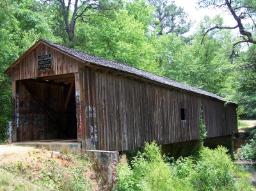
Coheelee Creek Covered Bridge - Southernmost in the United States

Just outside of Blakely in Early County stands the Coheelee Creek Covered Bridge, the southernmost original covered bridge in the United States.

Built in 1891 at the old McDonald Ford over Coheelee Creek, the bridge is 96 feet long and was constructed at a cost of only $490.41. That was actually a substantial sum in that day and time, but it was the work of builder John William Baughman that really stood the test of time.

The classic old bridge, weathered and charming, no longer carries car traffic but still feels solid to the feet as you walk across it. Like many such structures, it does suffer from vandalism and is not as well-kept as it could be, but to see a covered bridge standing so far down in the Deep South is truly remarkable.

The Coheelee Creek bridge is even more unique because it spans one of the few waterfalls to be found this far down in Georgia. The rushing water of the creek tumbles over rocks create a small cascade or fall that can be heard as you approach the bridge.

To learn more, please visit www.exploresouthernhistory.com/coheelee1.